
Single-Agent Beats Multi-Agent at Equal Budget
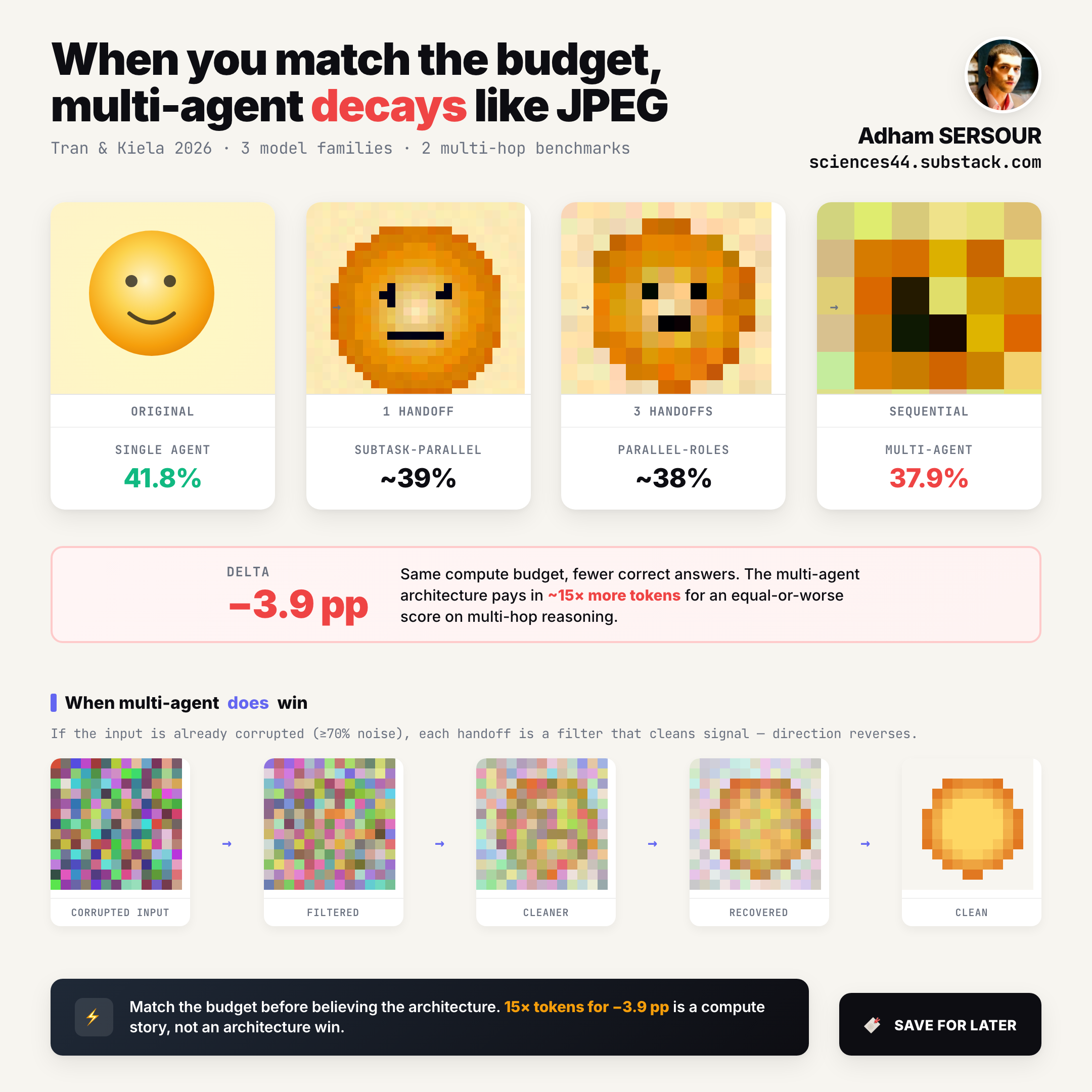
Anthropic published a blog post a few months ago saying their multi-agent research system (lead agent Opus 4 plus Sonnet 4 subagents) scores +90.2% over single-agent Claude Opus 4 on their internal research evaluation. The same post also mentions the system uses about 15 times more tokens.
I wanted to dig a bit more into what was actually going on. I came across a study that holds the token budget fixed and compares single-agent against five multi-agent architectures (Sequential, Subtask-parallel, Parallel-roles, Debate, Ensemble), across three model families (Qwen3-30B, DeepSeek-R1-Distill-Llama-70B, Gemini 2.5), on two multi-hop reasoning benchmarks.
At a 1000-token budget on average: single-agent scores 41.8%, Sequential multi-agent 37.9%. The pattern holds at 2000, 5000, 10000 tokens. And it reproduces across all three model families.
The reason behind the result is mathematical. Let Y be the correct answer, C the full context the single agent sees, M the messages the agents exchange. Since M is derived from C, the Data Processing Inequality says I(Y;C) ≥ I(Y;M). Every handoff between agents is a compression of context. And compression cannot add information about the answer. The multi-agent architecture cannot, by construction, exceed what a well-utilized single agent already sees.
A separate study (PlanCraft) measures drops of 39 to 70 points depending on the multi-agent architecture under matched compute, in the same direction.
A few limits worth naming to stay honest. The study is still a preprint, and its benchmarks cover multi-hop reasoning on general knowledge, not coding or browsing. It also acknowledges its boundary: when the single agent's context is too polluted for it to extract useful information, for instance if 70% of tokens are replaced with noise or off-topic sentences are injected, the multi-agent eventually overtakes it because its filtering and decomposition steps stabilize the reasoning. That noise threshold matters. Production contexts are often long, but they are rarely 70% corrupted, and long-context degradation is a slower curve than adversarial substitution noise. Multi-agent also keeps the edge on tasks that are intrinsically parallel, which is exactly where Anthropic's +90% lives.
Five questions to ask before believing the next "multi-agent beats single-agent by N%" claim:
1. Is the thinking-token budget matched between conditions? 2. Does the multi-agent system make many sequential API calls counted as a single inference? 3. Is the task genuinely parallel, or sequential reasoning? 4. Is the single agent's context too degraded for it to manage on its own? 5. Was a longer-thinking single-agent baseline tested?
If any answer is "no", the multi-agent win is likely a compute story, not an architecture one.