
Your Agent Reads the Rules, Then Ignores Them
If you've ever watched your agent read your instruction file (claude.md, agents.md, .cursorrules, whatever yours is called), acknowledge it, and then ignore it anyway, you've already felt the new hard problem in agent memory. The agent finds the rules. It just doesn't apply them.
It happens across products and across model backends. Whichever vendor you're on and whatever file format you're using, the complaint stays the same: rules read at the start, then quietly ignored mid-task. The agent can recite the rule it just broke. It still chooses something else.
The pattern can be summed up as "advisory versus mandatory." The agent treats the rules as advisory and falls back to its defaults. That distinction sits at the policy layer of agent memory.
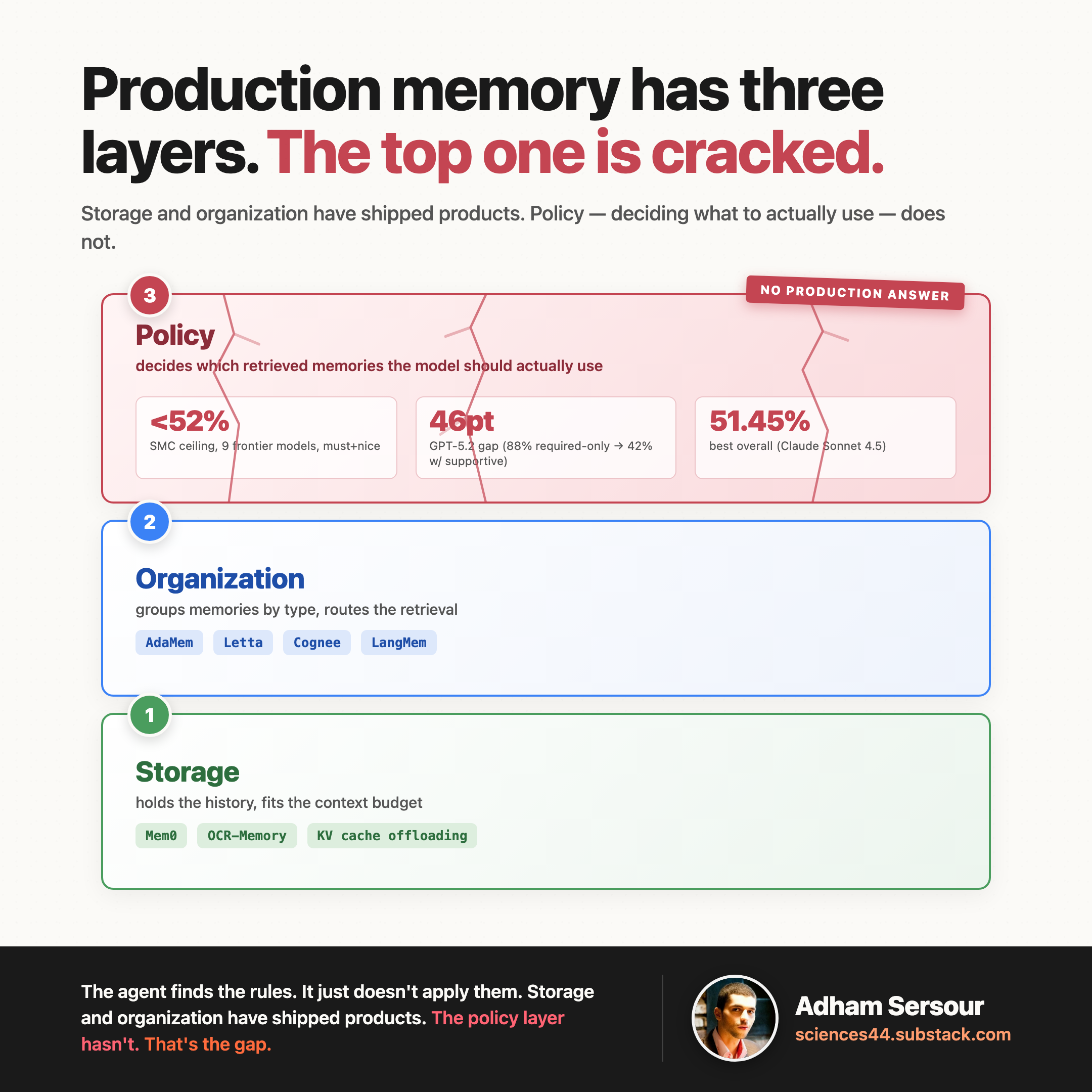
Agent memory in production has three layers. The first two get most of the attention. Storage is layer one, where Mem0, OCR-Memory and KV cache offloading hold the history and fit the budget. Organization is layer two, where AdaMem, Letta and Cognee group memories by type and route the retrieval. Policy is layer three, the part that decides which of the retrieved memories the model should actually use. The third layer has no production answer.
Where vendors address it at all, they patch it by hand. Anthropic's patch is probably the most public one. Before every Claude Code turn, the system injects a reminder that says "this context may or may not be relevant to your tasks. You should not respond to this context unless it is highly relevant." That sentence is a hand-coded policy decision telling the model that supportive memory is optional, and it produces exactly the behavior users are running into. Other platforms run their own variants of the same patch.
A new arXiv benchmark called StratMem-Bench, focused on multi-session character dialogue, recently put a number on the same idea. The benchmark tests nine frontier models (GPT-5.2, Claude Sonnet 4.5, Gemini 3 Pro, DeepSeek-reasoner, Llama 4 Maverick, Qwen3-Max, and three more) across three memory categories: required, supportive, and irrelevant. When only required memories are in the pool, the best models score in the 80s and 90s on strict compliance. Once supportive memories are added, no model crosses 52%, and the best overall score across all nine is Claude Sonnet 4.5 at 51.45%. GPT-5.2 sits at 88% in the easy condition and 42% in the harder one, which is the structural gap, not the same model destabilizing.
The benchmark studies virtual character dialogues, not coding agents. The finding transfers because the failure mode is identical in both cases: required information gets through, supportive context gets dropped.
This is a diagnostic you can run today. Take any memory pool your agent retrieves, and label each entry as required, supportive, or irrelevant. Watch what your agent does with each. The required entries should make it into the response. The irrelevant entries should be suppressed. The supportive ones, the entries that are relevant but not strictly necessary, are where every frontier model loses points. That's the gap no vendor has shipped a solution for yet.
Last time your agent read your rules file, told you it understood, and still wrote against your conventions, that was the policy layer talking. What's your patch?