
AgentArk: Multi-Agent Intelligence, One Forward Pass
There's a pattern I keep seeing in multi-agent projects.
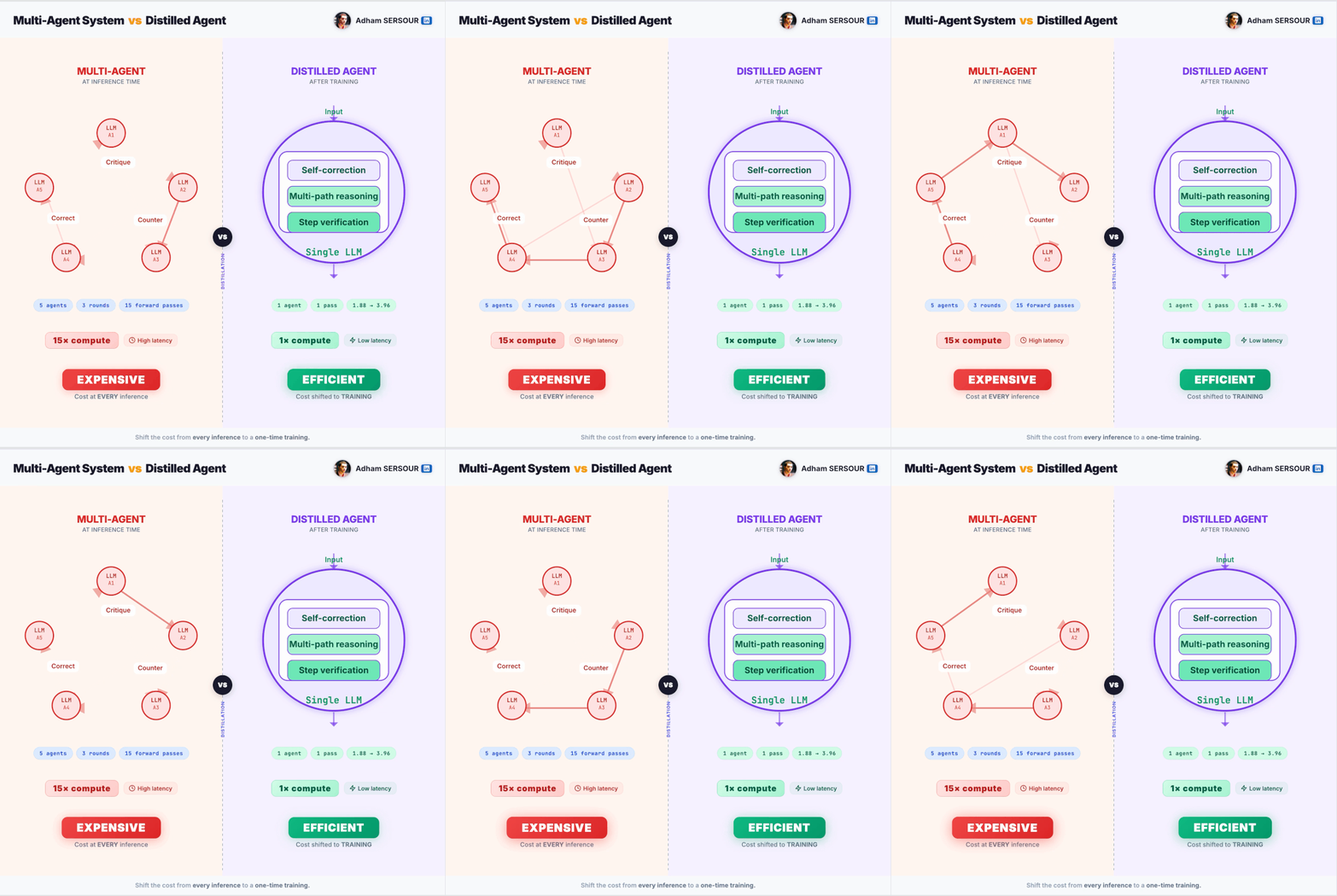
You deploy 5 agents that debate each other. Round 1, round 2, round 3. Each agent critiques the others, corrects its mistakes, and after 15 forward passes... you get your answer.
It works. But in production, that's 15x the cost of a single LLM call. And each round adds error propagation risk.
AgentArk asks the right question: do you actually need 5 agents at inference time?
Their answer: no. What makes multi-agent systems perform well isn't the topology, who talks to who. It's the reasoning behaviors that debate produces: self-correction, multi-path exploration, step-by-step verification.
And those behaviors can be distilled into a single model.
The pipeline in 3 phases:
1. Generate multi-agent debates, collect reasoning trajectories 2. Filter: keep only traces where an agent gets it wrong THEN corrects it 3. Train on those trajectories, with process-aware supervision at each step
Result: the distilled model goes from 1.88 to 3.96/5 in reasoning coherence. One forward pass instead of 15.
The fundamental principle: shift the cost from runtime to training. Every multi-agent inference you're paying 15x for is a training signal you're wasting.
What you lose: real-time collaborative correction and ensemble redundancy. What you keep: performance close to the full multi-agent system, at a fraction of the cost.
The question changes. Instead of "which multi-agent framework should I use?", it becomes "when does my multi-agent system become a training dataset?"