
AI Assistance Reduces Persistence
People who used AI for problem-solving got worse at problem-solving (nuanced, see below).
A study with 1,222 participants gave people math and reading problems, with and without AI assistance. After 10-15 minutes, the AI was removed. Everyone took the same test alone.
The AI group solved only 57% of problems. The control group solved 73%. And the AI group gave up on 20% of questions, nearly double the control's 11%.
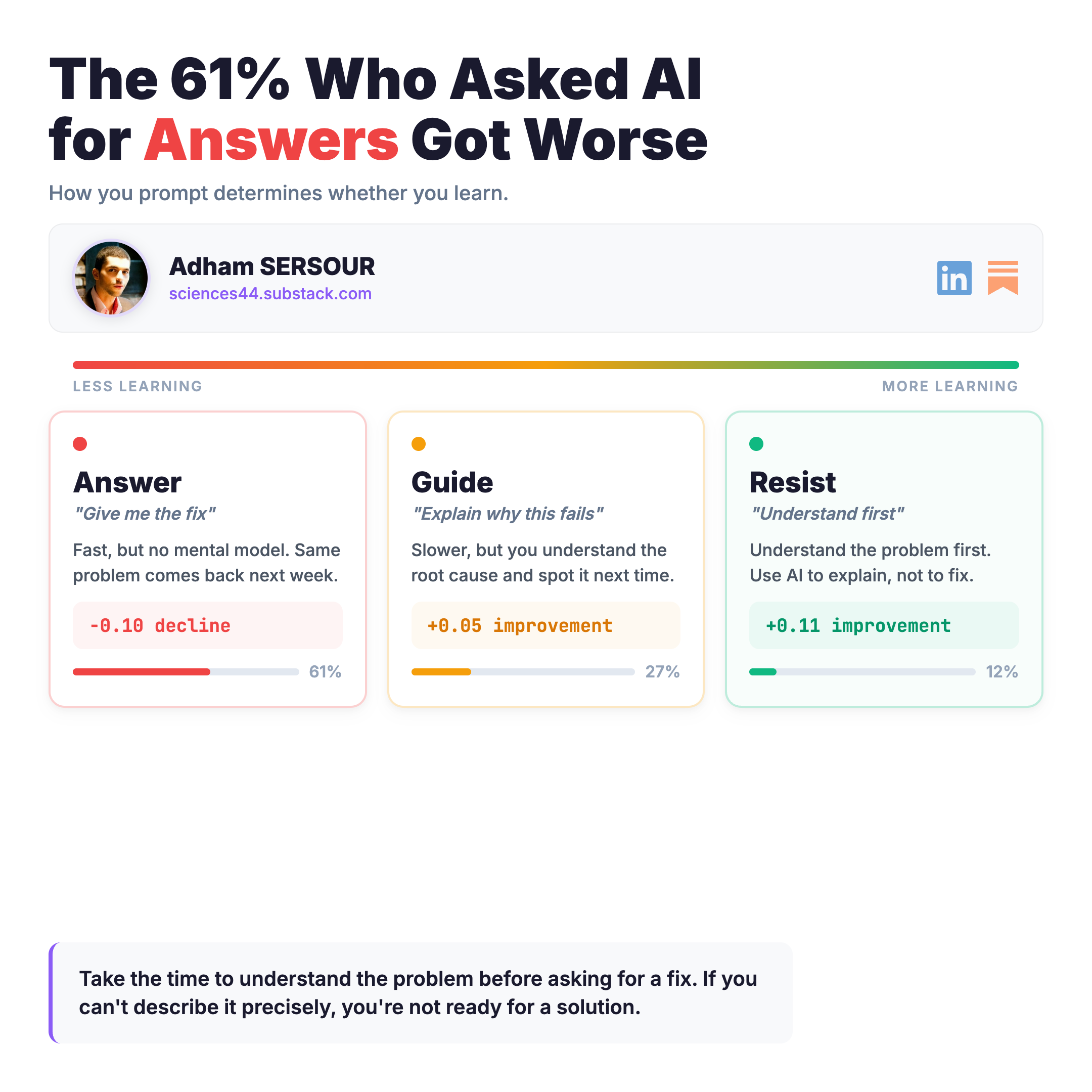
The real data is in how people used the AI. 61% asked for direct answers, not hints, not clarification, just the answer. 27% asked for guidance. 12% didn't use it at all.
The results by group (all from Experiment 2, same metric, pretest-to-test score change):
→ Direct answer users: 0.10 decline → Guidance users: +0.05 improvement → Non-users (had access but didn't use it): +0.11 improvement → Control group (no AI at all): +0.01
Important caveat: the 61/27/12 split wasn't randomized. Direct-answer users had lower pretest scores, so prior ability is a confound. This is correlation, not clean causation. But the pattern is consistent across all three experiments in the study (preprint, Liu et al., 2026).
I notice this in my own coding, specifically when debugging or working through complex problems (not when generating boilerplate, that's a different story). When I ask for a direct fix and paste it in, the problem comes back because I never understood it. When I ask "explain why this fails," I actually learn something.
So I started tracking how I use AI, and three modes showed up:
Answer mode is "just give me the fix." It's fast, but I keep hitting the same issues because I'm not building any mental model of the problem.
Guide mode is "explain why this fails." Slower, but I understand the root cause and I can spot similar bugs the next time they show up.
Resist mode is taking the time to understand the problem before reaching for any solution. Reproducing it, tracing the flow, asking the AI to explain what the code does rather than how to fix it. Most of the time, the bug is completely different from what I initially assumed.
Ever noticed how the bugs that haunt you are never the ones you struggled with? They're always the ones you skipped over too fast.
My rule now: take the time to understand the problem before asking for a fix. If I can't describe the problem precisely, I'm not ready for a solution. I'm just asking the AI to guess for me.
Try tracking your own usage for a week. Every time you prompt an AI, mark it: answer, guide, or resist. The ratio tells you a lot about whether you're actually learning or just moving faster.